
From Planning to Assembly in 180 days
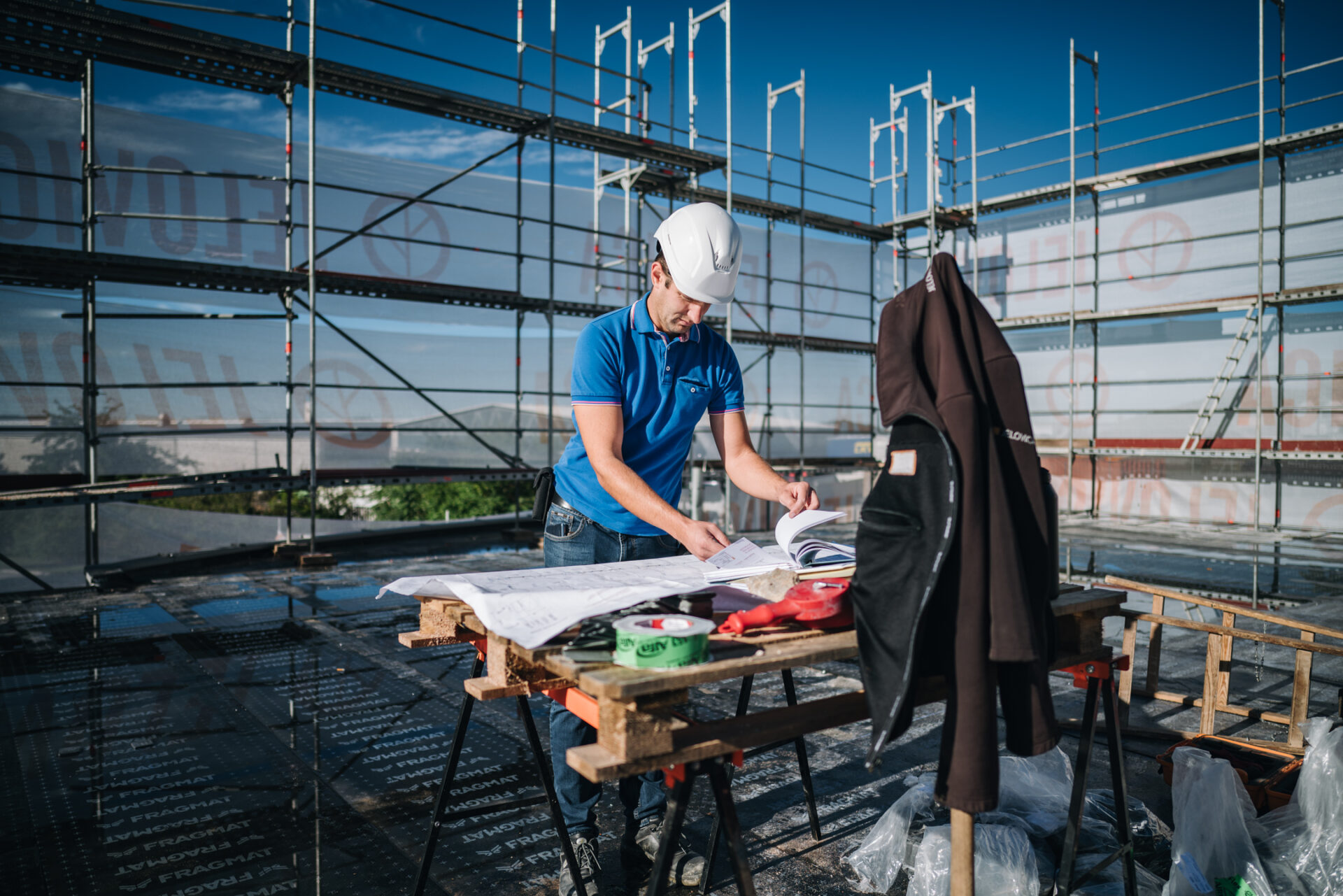
How Jelovica Delivers Speed, Precision, and Predictability in Prefabricated Timber Construction
In today’s European construction market, delivering projects on time is no longer primarily a question of materials or demand. The real constraint has become labour availability, site coordination, and schedule risk.
Prefabricated timber construction addresses these challenges not by simplifying buildings, but by reorganising how and where work is done. At Jelovica, our role is to take the most time-critical and labour-sensitive phases of a project and move them into a controlled, industrial environment — while keeping investors fully in control of scope, quality, and final execution.
This article explains how Jelovica supports developers and investors through the four key phases of a prefabricated timber project: planning & development, production, delivery, and assembly — and why this approach consistently results in faster, more predictable outcomes.
1. Planning and Development: Decisions Upfront, Certainty Downstream

In the first phase (6–10 weeks) the Jelovica engineering team converts the architectural concept into shop drawings. Structural calculations are produced to EUROCODE 5 (timber) and EUROCODE 8 (seismic); we deliver the BIM model in IFC format for coordination with the main contractor and CNC files that go straight to our machines in Preddvor, Slovenia.
All key decisions are closed before production begins: construction system (timber frame / CLT / hybrid), energy configuration (Optima / Compact / Natural), window type and façade finish, location of services and connection details. These decisions are made in the design office, not on site — where every change would mean delay and unbudgeted cost.
At the end of the phase the investor receives: shop drawings (DWG, PDF), BIM model (IFC), detailed cost breakdown, and binding programme. Without these documents the project does not move to production.
2. Production: Weather-Neutral, Dimensionally Precise
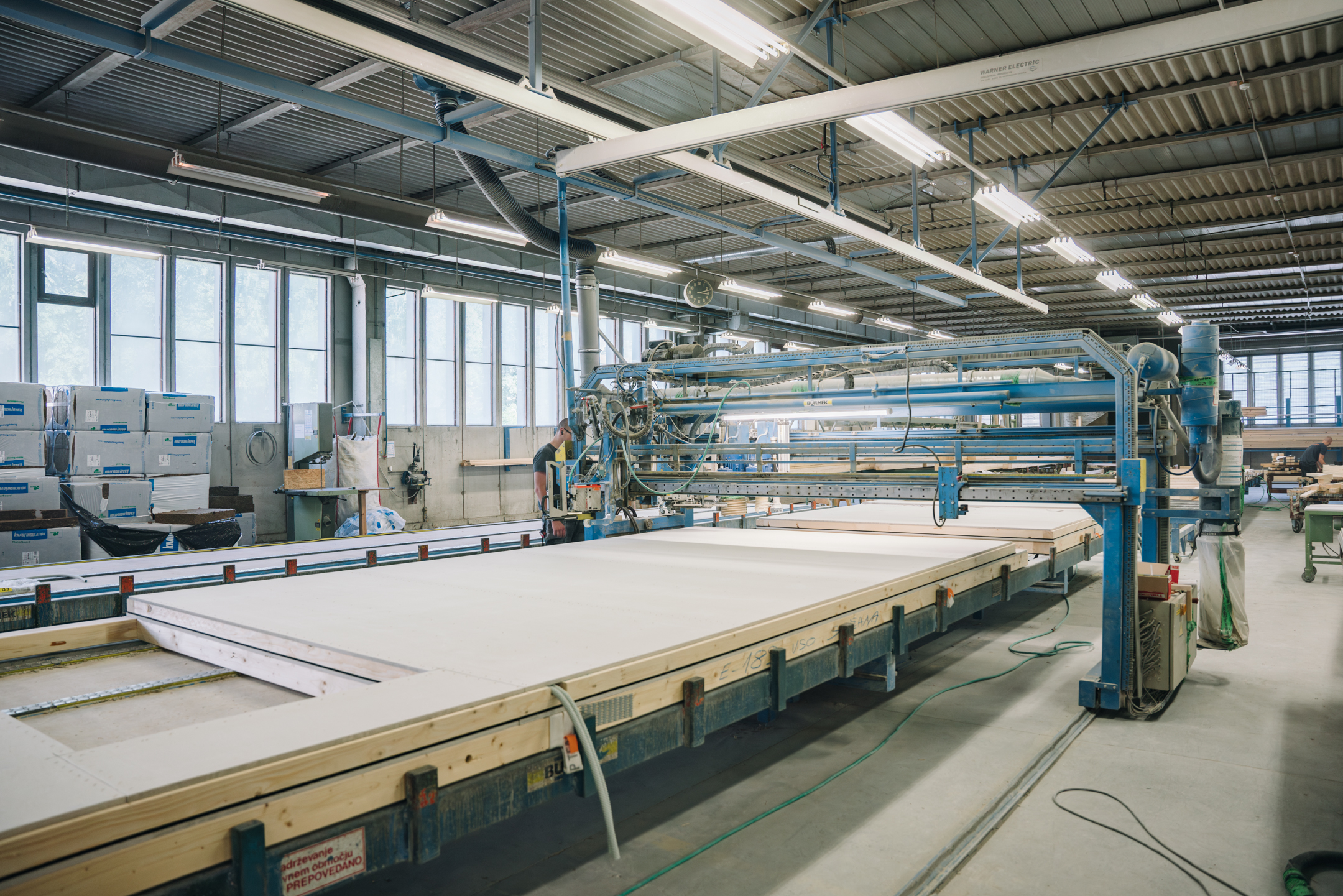
Once planning is complete and designs are frozen, the project moves into production — the phase where prefabrication delivers its greatest advantage.
At our facility in Preddvor, CNC machines process timber elements to ±2 mm tolerance — a precision that simply cannot be achieved on a conventional site. Timber moisture is held below 18%, ensuring dimensional stability after assembly. Every element carries a unique identifier documenting material, production date and QC sign-off.
The key advantage of factory production is subsystem integration: Jelovica windows, integrated shading, and base façade panels are installed directly into the wall panels. This cuts the number of on-site subcontractors by roughly 60% — fewer parties, fewer coordination interfaces, fewer delays.
Production capacity: 80 m² of wall elements per day. A typical single-family house (130 m²) requires 4–6 production days; a 20-unit multi-residential building 8–14 weeks. While production runs, the site works in parallel (earthworks, foundation slab) — no waiting.
3. Delivery: Site Coordination and Transport
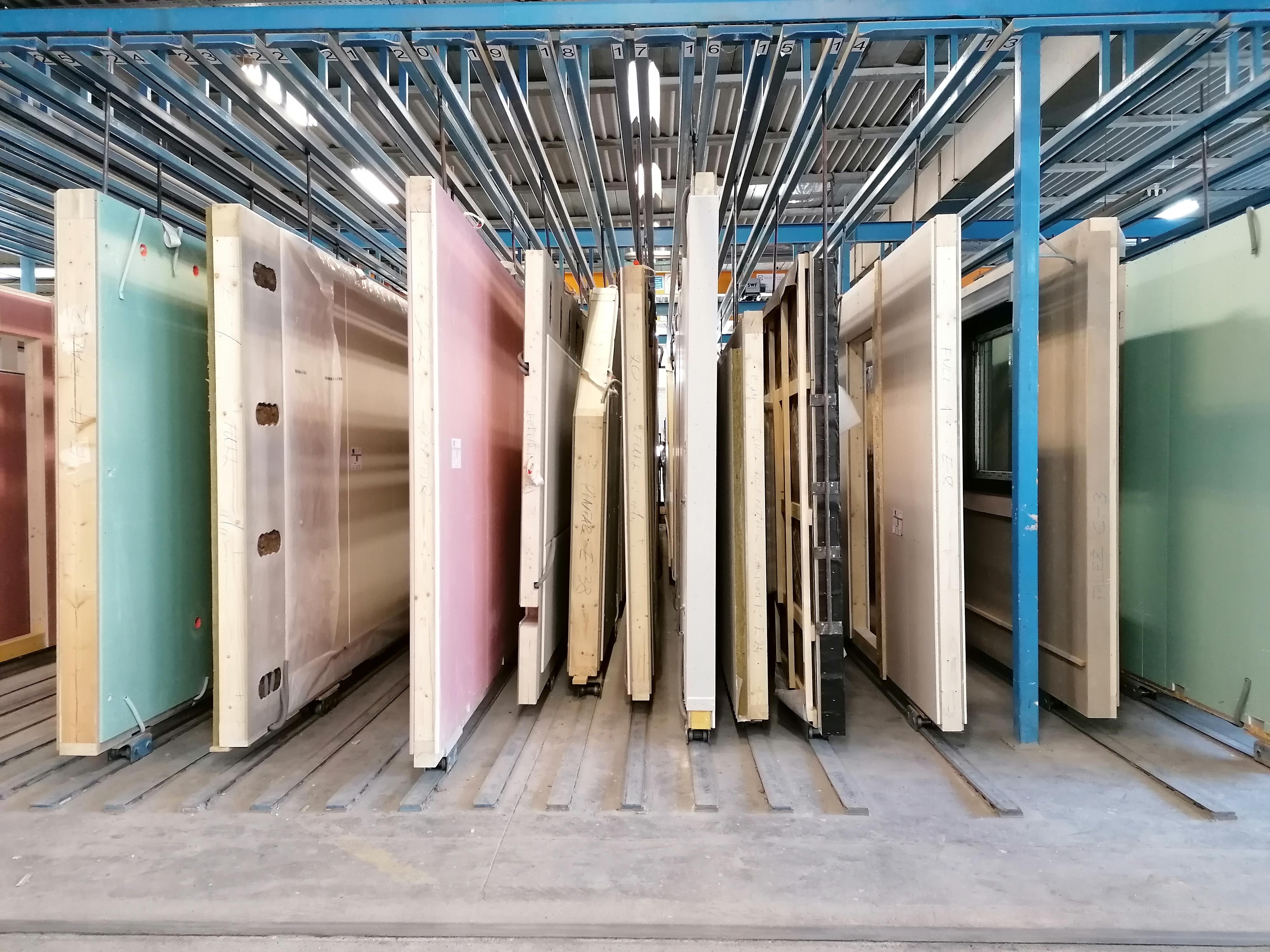
Delivery begins 1–3 days before scheduled assembly. Prefabricated wall panels and CLT elements up to 12 m sometimes require oversized transport permits, organised by our logistics team. We work with international hauliers who have been our partners for over 20 years — drivers know site logistics and coordinate arrivals to the minute.
Trucks arrive in a precise sequence aligned with the assembly phase: ground-floor walls first, then floor slabs, then the roof structure. This just-in-time principle reduces the storage space needed on site and enables continuous assembly without waiting.
Before the first truck arrives, the site must be ready: foundation slab completed to ±5 mm tolerance, truck access (width ≥ 3.5 m), 32A electrical connection for the control panel, and crane. Technical site requirements are issued 4 weeks before delivery.
4. Weather-Tight Envelope in 5–10 Days
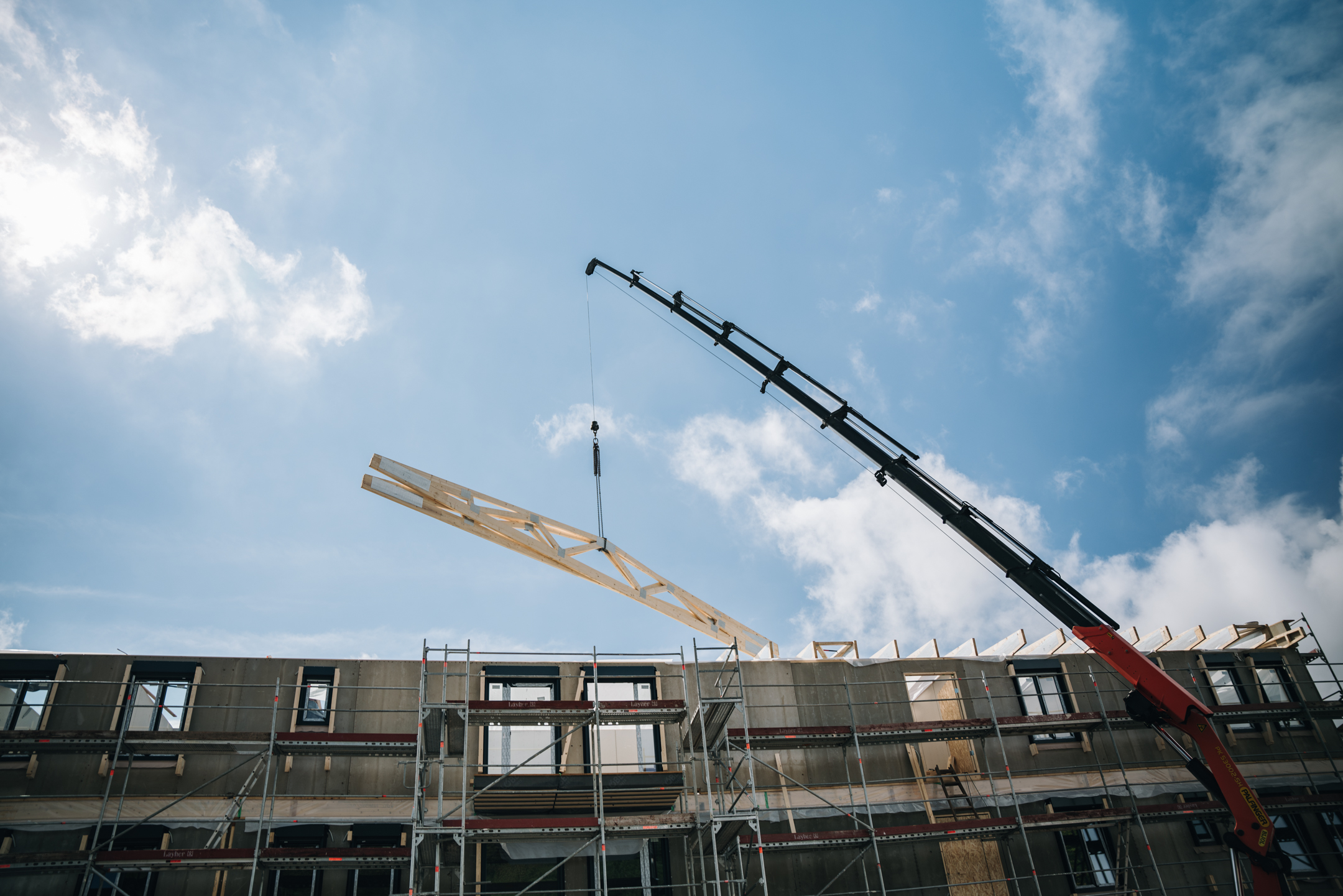
Our certified assembly team (or a certified local partner in our export markets) erects the load-bearing structure of a single-family house in 5–10 days. A 24-unit multi-residential building: 4–8 weeks. Every team member is regularly trained on our Termo, Optima, Compact and Natural systems.
After assembly is completed, the building envelope is closed: preparation for electrical installations is in place, insulation and windows are already integrated into the walls, and the roof is sealed. This is the “weather-tight” milestone, a stage that conventional construction typically reaches only 3 to 4 months later. Interior subcontractors for installations, final finishes and equipment can start work immediately, independently of weather conditions.
At this stage, the site is handed over to the local general contractor, who completes the project. Our project manager remains available for technical support and coordination until the building handover.
Why prefabrication delivers the 180-day cycle
180 days is not just a pharase — it is the mathematical result of parallel execution. Traditional construction is serial: prepare the site, pour the foundation, raise the walls, close the roof. Each phase waits for the previous one.
Prefabrication enables parallel execution: while earthworks and the foundation slab proceed on site, we already produce wall elements in Preddvor. This parallelism saves 3–4 months of programme. In addition, with 70% of work done off-site, the site is weather-independent. Every rainy week in traditional construction means 1–2 weeks of delay — in our model, rain means production continues normally in the factory.
For the investor, this means faster IRR, shorter time-to-market and lower financing costs (interest during construction). For the main contractor, it means fewer coordination risks and a programme they can rely on.
Risk reduction at every phase
B2B investors do not buy a building — they buy predictability and speed. Every risk that prefabrication removes translates directly into project safety and IRR calculation.
Labour risk: 40–50% less labour required on site (only the specialised assembly team), so labour shortages in the local market have less impact. Weather risk: 70% of work happens in the factory, independent of conditions. Coordination risk: fewer subcontractors on site means fewer interfaces and fewer points where delay can originate.
Quality risk: factory production is documented with daily QC sign-off — non-conformities are corrected before shipment, not on site. Schedule risk: programme fixed in contract, backed by liquidated damages for delay.
Frequently asked questions about the 180-day cycle
The 180 days measure the period from approved shop drawings (after contract signature) to the weather-tight milestone: load-bearing structure complete, windows installed, roof sealed. The cycle does NOT include pre-design (concept design, building permit), nor interior fit-out and services.
In that case the first phase (Planning and Development) extends to 8–12 weeks instead of 6–10. The 180-day cycle starts only once design is complete at shop-drawing level. We recommend engaging Jelovica during pre-design to coordinate structure and connection details from the beginning.
Single-family house up to 200 m²: 180 days is realistic, often completed in 150–170 days. Multi-residential 8–24 units: 180–220 days. Complex public buildings (kindergartens, schools, multi-residential over 30 units): 220–300 days. Before quotation we produce a project-specific programme.
Before production starts, the following are closed: (1) construction system (timber frame / CLT / hybrid), (2) energy configuration (Optima / Compact / Natural), (3) windows and façade finish, (4) floor plan and services location, (5) structural design and services routing. Changes from week 8 onwards are complex and cost-sensitive.
Our annual track record shows over 90% of projects completed within the agreed schedule. Each new project is managed with daily production monitoring and weekly assembly-phase monitoring. The schedule is contractually binding, supported by liquidated damages for delay.
No. The 180-day cycle ends at the stage of the closed structural building envelope, when the building is protected from weather conditions. Interior installations, such as electricity, water, heating and ventilation, interior finishes, as well as kitchen and bathroom equipment are carried out after this cycle, usually by local subcontractors. The total time from contract to move-in is typically 6 to 9 months, depending on the complexity of the project, the scope of interior works and the coordination of all contractors.
Jelovica has successfully completed more than 13,000 projects in over 80 years, across Slovenia, Italy, Switzerland and Germany. Selected references are presented on our website, while additional information about completed projects and investor contact details are available on request. View selected references.